
Articles by Barb Bernstein
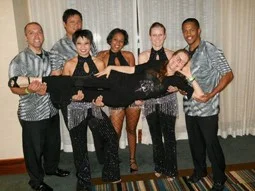
For an article on how to pursue learning to dance, read below.
Patience, Practice and the Pursuit of Excellence
By Barbara Bernstein, The Scene Magazine, March 15, 2009
An old joke goes as follows: A woman walking down a street in New York City stopped a passer-by and asked, "Excuse me, but can you tell me how to get to Carnegie Hall?" The gentleman answered, "Practice, practice, practice!"
A new book out by Malcolm Gladwell (author of Blink) makes a startling proposition about how to explain exceptional talent. Gladwell describes a principle he calls "the 10,000 hour" rule. He says that to be very outstanding at some skill-like a top flight pro tennis player-requires 10,000 hours of practice. That amounts to 20 hours a week for 10 years.
Whether you train to perform or just dance for fun, the same rules apply: you just cannot become highly skilled without lots of practice; and you cannot get a lot of practice without being comfortable making mistakes, picking yourself up and trying again. No matter how talented someone appears when they dance, they didn't start out that way. They made mistakes and kept on trying.
Just as children learn to walk before they run, students of dance learn to do things slowly before accelerating. It is best to learn new material first to very slow music and once the move is in muscle memory, gradually kick up the pace.
Slow tempos are very "forgiving." For example, if you have excess motion in your lead, you may be able to slog through a move to a slow speed. But a faster speed requires greater cleanliness to get through the move, which can be done once you have practiced the move enough to commit it to muscle memory.
It's important to recognize that knowing something is really a matter of degree, rather than all or nothing. You don't simply know or not know how to do a cross body lead, for example. You start out doing it hesitantly and with awkwardness, and the more you practice, the more confident and smooth the movement becomes.
Dancers may feel that they already know a move, and understandably want to learn new moves rather than review what they know. But since learning is incremental, the more you do it, the better you'll do it (at faster tempos, with less thought, adding embellishments).
That smoothness and improved technique is what makes you feel good to dance with and look great on the floor.
The Seven Sins of Salsa
By Barbara Bernstein and Glen Minto aka: Salsero, Latin Beat Magazine, December 2009
So you wanna learn how to dance salsa? Maybe you're already an aspiring salsero/salsera wanting to take your dancing to the next level. Well, congratulations - you found us! We're about to show you how to take your dancing to the next level by listing things to avoid when dancing. After years of discussing some of the finer points of dancing, two dedicated salseros (Barb and Salsero) have compiled their experiences of how to get the most enjoyment and learning out of dancing salsa. "The Seven Sins of Salsa" is a list of common, all-too-human mistakes that most of us make at one time or another (the authors included!). Avoiding these mistakes will help you get the most out of your dancing. By gaining skill and making your dance experience a joyful way to exercise and connect with others, you will have heaps of fun dancing salsa and gradually learn to dance better and better.
So here goes… The Seven Sins of Salsa
1a. Leading Yourself (for ladies) - by Barb
Dancing is a partnership activity that requires a coordinated effort by both the leader and the follower. As we all know, a person can feel and indeed be very alone in a crowded room, as connection is really a mental state. Likewise, one can dance with another person and not be responsive to them or be aware of them. For ladies, what this would mean is anticipating what the leader is doing and moving herself without waiting for or responding to his lead. Ladies often don't realize they are doing this when they are! A good example is that a lady may sense that a turn is coming and turn herself without waiting to be led. Or she may get the beginning of the lead and then move herself through the turn faster than the leader was leading her to turn. In both cases, she is not moving as he leads her, but has "taken over the lead." This is unsatisfying for the leader because, in a sense, he's not really needed. Even in Rueda de Casino, the follower should wait for the lead even though she knows the move!1b. Out-Shining The Ladies (for men) - by Salsero
Let's face it guys, the ladies are just sexier than we are. Thank goodness too! But seriously, when the ladies look good, we look good. When the ladies don't look good dancing, we don't – no matter how good we are. Trust me on this one guys, you do NOT want to be one of those salseros that does all the cool tricks, dips, and shines, with a lady that just started dancing two weeks ago – even if you know how to do the cool tricks, dips, and shines. What do I mean? Let's examine a typical scenario: You're dancing with the girl and suddenly you decide you want some "me time." You give the lady a free spin and let her do her thing while you do your thing. If you see the lady doesn't know what to do, or she's only doing the basic steps instead of a really cool eye-catching shine, then don't overdo it with your shine either. Always be mindful of your partner's ability to dance and the level she's dancing at. Doing so will go a long way in helping you master leading in general and help you increase your skill in dancing with multiple ladies. Think about it this way: Would you rather dance with one beautiful girl at a night club or all the beautiful girls at a night club? If the answer is with all the beautiful girls, then try not to commit the sin of out-shining your lady!2. Dancing Off Time/Out of Rhythm to the Music - by Barb
Ahhh... Dancing off time - the dancer's nightmare!
First, we have to discuss what this means. If a person breaks on 3 or 4 instead of his intended 1 or 2, but does so consistently, is that off time? The answer to that depends on your definition of "off time." My own concept of being off time is not dancing in the rhythm of the music. To me, dancing consistently on any beat may not be fully correct, but the timing is predictable to your partner. It's keeping the music's tempo, at least. The most egregious meaning of "off time" is dancing the 4 beats in what is really 4 and a half beats of music, or 3 and a half beats of music, etc. In this case, dancing off time means dancing independently of the music's rhythm or tempo. This creates a disconnect between the movement and the music. The music provides merely a pleasant background to move to, but has no true bearing on the timing of the steps. This scenario is the most serious definition of "off time" and the one that I'm addressing. Sometimes, in such a case, the dancer grasps the beat but cannot make their feet move to that beat – they need practice moving feet faster. If after a lot of practice, the individual still dances this way, it's a good bet they cannot feel the music's beat. It's very hard to teach someone to feel that "musical pulse" if they don't feel it on their own. It feels uncomfortable to his/her partner to dance off beat in this manner because at certain points in time during an 8-beat phrase, dancers are stable and at other points in time they can be moved into a step. If both partners are not in time, then one partner may be trying to move when the other is stable or vice versa. It creates a kind of dance argument or disagreement. The partners are not working together. If you have been told that you have difficulty hearing the beat, you can pay attention to your partner's beat and try to match it even if you aren't hearing the music's beat. That way you are still in-synch with your dance partner. This will go a long way to mitigating the effect of difficulty with the rhythm.
3. Thinking There's Only One Right Way to Dance Salsa - by Barb
People unfortunately sometimes believe that the way they dance is the only right way. We all pick how we like to do things based on principles of what we feel looks best or feels best and natural to us, so of course our way is the way we prefer! Yet, while everything is not "relative" and there are some rights and wrongs, there are also many "acceptable" ways to dance. In Casino Rueda for example, there are often countless ways to do any given move as well as ways to style it. It's best to think of these approaches as just that: variable approaches rather than right or wrong ways to dance. This is particularly important in making a dancer flexible so he/she can dance with anyone. We all dance comfortably with our dance class friends or dance teammates. However, the world is populated by many who aren't in that set, and to dance with them, a great deal of flexibility and acceptance is helpful!4. Learning to Run Before You Walk - by Barb
This refers to dancers trying to learn advanced moves before they get a real handle on the basics. People are naturally attracted to flashy movements, but any lady will tell you that well executed and physically comfortable basics are more fun to do than poorly executed flashy moves. The latter are awkward and can even strain her while basic movements smoothly done can be quite satisfying and she'll show it in how she looks! So, for both leads and follows, be patient with studying the fundamentals as you learn them in layers. First, you get the moves, you smooth them out, and then you grasp them well enough to add styling/flairs. Finally, you grasp the basic elements at a deeper level...and the cycle continues. You learn this material better and better. It's like practicing scales for a musician; it's something you do for a very long time. Once you are very solid on fundamentals, the more advanced moves are easier to grasp, easier to do, and you will execute them more skillfully.5. Not practicing good dance etiquette - by Barb
This covers a host of "sins!" People can take up too much space on a crowded floor; they can dance to show off ("the sin of pride"); they may invade their partner's space and dance too intimately, etc. There are many etiquette rules than can be breached. Essentially, etiquette is a matter of being considerate of all those around you-your partner as well as others. Good etiquette is also aided by common sense. You don't want to do tricks on a crowded club floor as not only you and your partner, but those around you could get hurt, for example. Likewise, dancing to strut your skills doesn't make your partner feel important. (See sin 1b above). Dancing too close to a partner may also make him/her uncomfortable. If you are watching your partner's reaction, you may be able to read how they are receiving you and make adjustments; it's a matter of caring enough to be sensitive to their signals. This applies equally to those around you at a club!6a. Assuming That Errors Are Due to Your Partner - by Barb
Most mistakes have some influence from both partners. It's pretty rare that an error is due entirely to one person. If a couple is dancing, for example, and the lady doesn't have quite enough tension in her arms, the man must lead more forcefully to get her to follow. To avoid feeling yanked, the lady may loosen up further. The man must then lead even stronger. Many dance interactions are like this! Don't fall into the trap of thinking that mistakes require that the other person make a correction. Another way to think about this is that if one if the partners changes what he/she does, that alone may avoid a problem, even if the move isn't totally perfect. You can be aware of how to correct an issue even if your partner isn't doing something right, and compensate for them so the move can be executed. You cannot change someone else, you can only change yourself, and people who can compensate for others are much loved on the dance floor as that takes skill and consideration! Think about this: In a class, the teacher can generally dance with everyone and get through all the moves, but the students may have trouble doing the moves with each other. The strength of the teacher's knowledge of the moves enables the partnership to get through the move adequately despite the student's mistakes. So, make it your business to strengthen your own dancing, and don't worry if your partner isn't always doing things the best way.6b. It's Always The Guy's Fault - NOT!!! (for men) - By Salsero
Salsero here. Ladies, please move on to the next section…this is only for the guys.
Guys, have you heard that if anything goes wrong it's always the guy's fault? Quite frankly, most of the time, it's the ladies' fault. I mean, I've been hit in the face more times than I can remember (now I'm like a ninja expert at avoiding these unsuspecting hits from nowhere). Actually, the second to last time it happened, about a couple of months ago, I was in the bathroom bleeding for over an hour and had a bruise on my lip for DAYS (grrrr). The last time it happened, I didn't bleed at all but this girl hit me on my jaw so hard, it hurts when I try to yawn - even today! And that's supposed to be "My Fault???" But I digress - this article is about you, not me. Guys, we're men, and so we have to take being hit like a man. Feel me? If a lady hits you in the face, and you know it's entirely her fault, try to smile it off and proceed with extreme caution to finish dancing with her while you eagerly await the song to be over. Try not to storm off the dance floor and let the lady feel even more embarrassed than she does. That way, the other beautiful ladies who are waiting to dance with you and who saw what happened will know that you're a real gentleman. That being said, and to echo what Barb said, you have to be cognizant of your own leading ability. No one expects you to be perfect. But if you can develop an understanding of what went wrong AND WHY, you will be in a better position to try to avoid the same problem in the future. And so, while errors do happen, don't succumb to the sin of assuming that errors are due solely to your partner and try and not make the same error twice. I know, I'm preaching to the choir!
7. Not having fun!! - By Barb and Salsero
Taking yourself too seriously.
Dancing is often an expression of joy. Think of the victory dances players do after making a touchdown, for example. To keep that fresh, joyful approach alive on the floor, make sure you don't lose that outlook as you learn. Getting every step or technique just right takes a lot of practice. It isn't the end of the world to mess up a move or lose your balance on a double/triple turn. Most important is having a great time as you learn. That way you'll keep coming back and in time you will master what you practice! Remember that it's all about fun, and dance with love, joy, and playfulness in your heart. When your dancing comes from a place of loving music and movement, it will show through; and the technique will come in time. This attitude will make your own experience rich, and will make dancing fun for you and your partner.
Different Mindset on Teaching & Learning: Lessons from Dance Instruction
Exerpted from Barbara Bernstein’s “Salsa Dancing & Rueda de Casino Guidebook for Beginner to Advanced Dancers” Fall 2024 issue of American University’s The CFE Beat, (formerly CTRL Beat: Center for Teaching, Researching, & Learning)
A Fundamental Law: Learning Is on a Continuum
People generally understand that when someone learns to play a musical instrument, they don’t just have the ability to play it or not. It’s well recognized that this kind of learning is incremental; it keeps improving over time with practice. Learning a language is another example; it’s a gradual process.
But learning isn’t always thought of that way. In fact, our language itself tends to be binary in this regard. Students often say, for example, that they “know” or “don’t know” a dance move. Yet clearly, there is no on/off switch for learning dance steps. Dancers continually become faster and more polished over time. You might have studied a move and feel you know how to do it, but still not be able to do it smoothly or automatically. In that case, if something distracts you, or if the music is faster than usual, you may not be able to get through it. And yet in some sense, you do know the move.
According to Malcolm Gladwell, author of Outliers, to become a top-level expert in a skill, 10,000 hours of practice are necessary (though not sufficient). The average dance student may not be looking to become an expert, but Gladwell’s “rule” underscores the concept of incremental learning. It essentially means that continual improvement comes with continued practice.
When students learn a new dance move, they do it hesitantly at first. They may feel that they know the move after 25 repetitions—and sometimes want to go on to other moves. But after 500 repetitions, they’ll certainly know it much better. Students should keep all this in mind, as it helps them be patient with their progress as they keep practicing to improve.
Side Note ♬
Here is an analogous situation that helps clarify this issue. In a math class, if a student “knows” the multiplication tables but has to think for thirty seconds to figure out each answer, that student isn’t ready for long division. To do long division, the tables must be very automatic because there are so many calculations that have to be made in each problem. (Likewise, it wouldn’t be feasible to do the calculations needed to add, subtract, multiply, and divide with fractions, decimals, and percents—until the student can multiply faster!)
A student may be right in thinking he/she knows the multiplication tables. But that’s not what is important. What’s important is how well (i.e., fast) students know them. When students are first learning multiplication facts, they don’t have this perspective. But teachers do, which is why they drill this—to prepare students for what is coming.
To do advanced dance moves, the foundation of underlying moves needs to be very solid. It’s not enough to “know” the basic moves; students have to be able to do them automatically and smoothly in order to use those basic movements in more complex steps. It’s all about the continuum, which is why dance classes drill skills. Hopefully, understanding this can help prevent students from being discouraged as they work to progress.
An obvious implication of this is that students advance their skills when they review or drill moves they already “know.” The drill helps them achieve a greater level of skill and a deeper level of understanding the movement. This is especially true if they are guided to work on certain things as they dance. For example, a teacher may be guiding them to work on keeping stricter time with the music, or to be in the correct location with respect to their partner while stepping through a move, etc.
It is not unusual for students to equate being a good or advanced dancer with knowing a lot of moves. But many times, the way someone can really become a better dancer is to focus more on how they are moving and less on accumulating more steps.
Admittedly, it’s seductive to watch advanced dancers on the floor and it’s natural to want to learn the cool things they do! But in a class, the teacher may see that it’s more important for a student to work on improving underlying skills such as timing and making steps steady and even, for example.
Learning new moves can feel thrilling, but dancing well is more important.
People Can Go Farther Than They Think
The implication of the insights above are clear and encouraging… We have patterns of movement in our daily lives that we have been doing since childhood. No one should expect to learn different ways of moving without practice.
The key to learning most new dance skills is the patience to put in whatever time is needed to master them.
I’ve seen students start out very slowly, but they steadily improve and ultimately become strong dancers. With continued effort, you’ll be surprised how far you can go! We often think of how important it is for teachers to be patient with students when students are learning. But I believe it’s just as important for students to be patient with themselves.
Educators have done research on the importance of a “growth mindset” which means holding the belief that everyone can improve their skills with continued effort or practice. This contrasts with the outlook that ability is innate and cannot be changed, which implies that some people can’t improve that much. Those who subscribe to the latter belief don’t go as far and may feel “defeated” when they aren’t doing well at a task.
By contrast, people who believe that improvement is always possible with more effort keep plugging away. They ultimately go much farther. Carol Dweck’s popular Ted Talk describes the research on this and offers a very empowering message!
It’s helpful to recognize that the key skills in Salsa and Casino dancing are the ones “between your ears.” You don’t need to be strong, fast, or flexible to become a good dancer. Dance teachers are fond of saying “If you can walk, you can dance.” And I’d argue there are also ways to adapt dancing for those who can’t walk.
Moreover, the styles of dance in this book are accessible to everyone—young and old alike. Many sports and physical activities require strength or speed, which is difficult for older people. But the necessary skills for partnership dancing are simply understanding footwork, timing, and movement, plus the patience and empathy to work cooperatively with a partner.
“I've missed more than 9,000 shots in my career.
I’ve lost almost 300 games.
Twenty-six times, I’ve been trusted to take the game winning shot and missed.
I’ve failed over and over again in my life.
And that is why I succeed.”
—Michael Jordan