
Learning to Dance: Techniques That Help Dancers Learn (Part 2 of 3)
[banner]
[toc]
Don't Bounce Your Steps
You should generally not bounce your steps in Salsa or in Rueda de Casino dancing. The knees are bent very slightly throughout the steps, and the head stays at the same level so that steps are smooth. When knees are bent and then straightened even slightly, this creates a bounce where the head goes up and down. Instead, what experienced dancers do is keep their knees slightly bent about the same amount throughout the dance so the head remains level. (They don’t look bent since it’s very slight. This is referred to as having a “soft knee.”) The movement looks more or less like the dancer is taking walking steps.
Keep Your Weight Forward
Keep your weight over your center and very slightly forward; don't lean back on your heels. “Back-weighting” slows you down as you have to shift your weight forward before you can take the next step. This in turn, can cause dancers to be off time.
Watch & Synchronize With Others
Remember to watch other experienced dancers and match their moves so you are in synchrony with them. Mimicking others is a useful technique in this dance, but not everyone remembers to do it.
Watch the Caller & Listen Carefully
Listen to and watch the caller so you don't miss a call. That is the responsibility of every dancer in the circle.
Keep the Circle Circular & Tight!
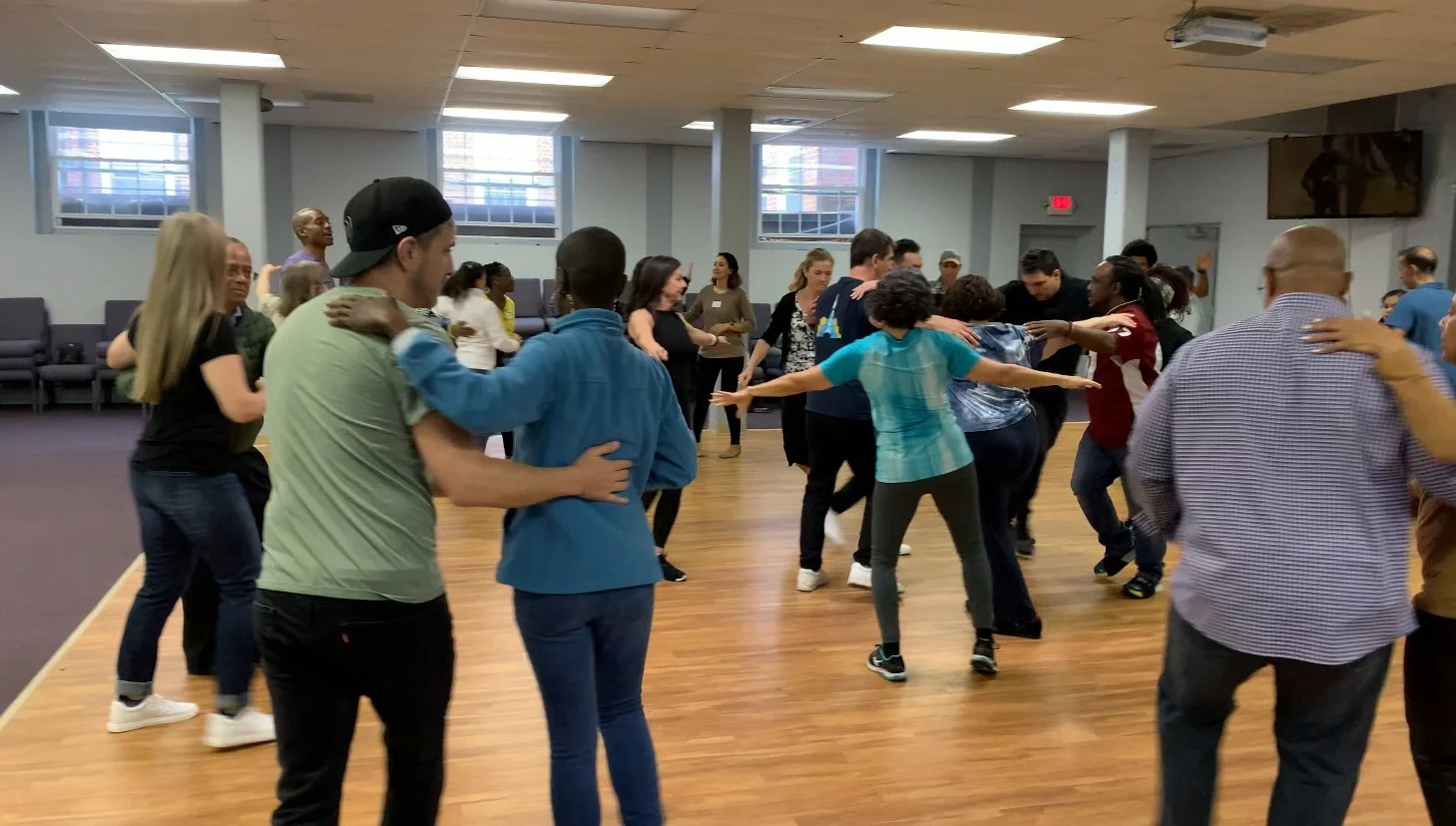
Paying attention to the shape of the circle is everyone's responsibility. Try to stay close to the perimeter of the circle, especially on moves where it's easy to pull away.
Stay Close to Your Partner
Both partners generally should keep enough tension in their arms so their elbows stay bent. If either partner extends their arms fully, the dancers get too far from each other and leading is compromised.
Keep Your Feet Moving In The Quick Quick Slow Rhythm
Let me tell you what it feels like to be a leader and come to pick up a new partner who is standing still. It feels like the follower has stopped dancing; it's unsatisfying. Followers should keep their feet moving in the quick quick slow rhythm, even if they aren't "going anywhere," so they look and feel like they're actually dancing! This applies to steps where leaders stay in place, too.
The group spirit of a Rueda circle is augmented by having everyone move in the same rhythm. So even if you don't have to take a step to move or turn, keep the feet going in rhythm. This also helps ensure you'll know which foot to step on when you do need to move!
How Much Lead Is Too Much?
There is a lot of variance in how forcefully people lead. Likewise, there is a lot of variance in how much lead followers prefer. There is no one correct answer to the question of how much lead is too much. Personally, I prefer as much lead as necessary for clarity and no more (a sort of "economy of lead" principle). If you start the follower in motion, and momentum will continue moving the follower along, there is no need to continue pushing. That doesn't mean you don't provide contact. But force isn't needed to get someone to go where they are going to go anyway!
Or if you are doing a turn or alarde, there is no need to raise the follower's arm very high over her head. You just need to clear her head. To raise the arm high, the lead has to be more forceful. So you can keep the lead gentle by moving the arm only as high as needed. It takes a greater level of sophistication as a dancer to lead effectively but gently. It's much easier to lead with force.
There is one more notable point regarding the strength of the lead. If someone has too little lead, they'll find out. The follower won't know what to do, so it's obvious a firmer hand is needed. But if your lead is extremely strong, you don't get feedback on that as readily. Partners may be able to follow you but they might not be comfortable. This is good to bear in mind.
Frame & Tension Make Leading and Following Possible
Following a lead properly requires some basic understanding of frame and tension. This is something people develop over time and experience. When followers who aren't experienced dancers first try a turn, they often let their arm move back but don't move their bodies, as their partner tries to lead them.
To follow a lead, the follower's arm maintains a shape so that the follower can be pushed/guided (gently!). Because followers hold the shape or frame of their arm, the leads can move them by moving their hand at the point of contact. I have seen several interesting ways to explain the concept of frame. One is that ladies must be able to see their right arm out of the corner of their eye. So the arm never goes outside their range of vision. Thus, when the arm is pushed in an effort to turn the lady, her body has to go with the arm—and (voilà!) she has been led!
Another unique way to explain this was shared with me by a friend, Melinda Turner. She said she was in a class where the teacher passed out tennis balls to the followers. They were all told to put the ball under their right armpit and dance without letting it fall. Then, when the follower was turned to the right, she had to hold a rigid frame and move both her arm and body, or the ball would fall.
I've never quite had the nerve to bring tennis balls to class, but this is an outstanding way to convey the concept of frame. I have found that even just describing this in words from the beginning, and asking the followers to imagine a ball is under their arm, is enough to get the concept across.